Can we talk about my cortisol levels? Because today was stress-full! Not in an anything-serious-happening sort of way, more of an I’m-irritated-and-I-feel-my-heart-racing-please-let-me-go-have-a-nap way.
For irritating things #1, you need some background info. Like “my classes start at 8am every day.” Or “it takes me 3-5 minutes to drive to campus most days.” And “the walk from the parking lot to my first class takes 10 minutes no matter how quickly you scurry.” Got all that? Because I woke up at 7:47. Yeah. I should have known that staying up late with Adam and eating cookies and big bowls of mac n cheese was not going to leave me well rested. I ended up only being 3 minutes late to class though. Extrapolate that and think about just how pretty I looked today.
Irritating thing #2 is that we don’t have our tests from last week back. I’m not irritated with the teacher because I know time-consuming grading can be. (Though I am irritated with another teacher because we took a test in that class a month ago and still don’t have it back!) But it is irritating to have to keep obsessing over how I did. I think one test went really well and the other went really, really poorly so for a multitude of reasons I’d like to have them back and be able to just move on!
Since I clearly didn’t pack any food and I had group meetings during all of our breaks, my first meal of the day was consumed at 3pm. To keep myself from going crazy I bought a half-sweet pumpkin spice latte on my drive home.
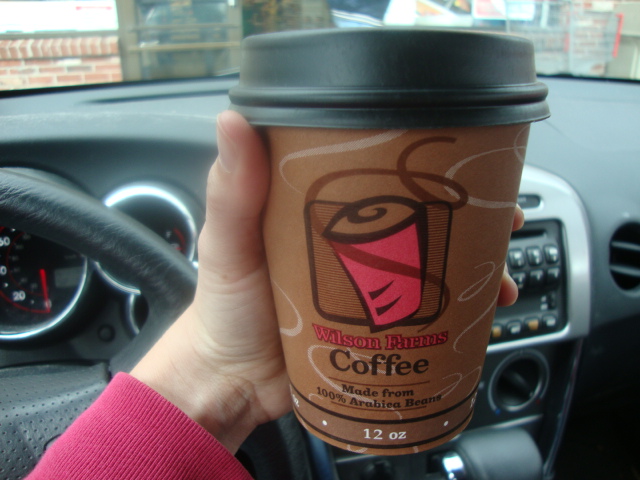
And then I tucked into this –
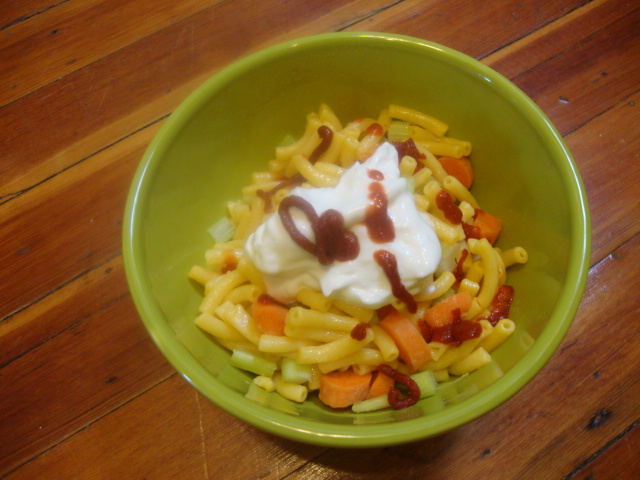
That’s a leftover serving of mac ‘n cheese with chopped carrots and celery stirred in and Greek yogurt and Sriracha on top.
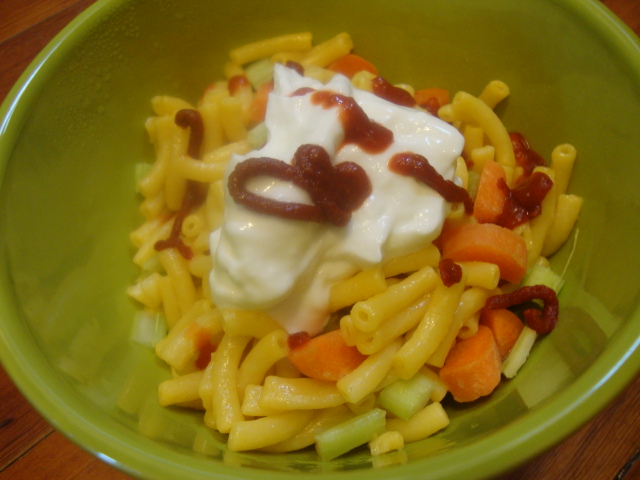
I went a bit heavy with the Sriracha, I should have known that my mouth would be on fire. I ended up just stirring everything together.

This killed the cheesiness (favorite flavor 1) but the end product was very spicy and creamy (favorites 2 and 3). I should have known that it’d be perfect.
Plans for the evening include –
- school work (hopefully)
- dinner (for sure)
- stress reduction (any suggestions?)
- a workout (please, please, please, Universe, give me the motivation to do this!)
Fun Fact Fridays Monday
Here are some of the things I hope I knew during my test last Friday –
- Sugar alcohols, which are naturally found in some foods, are produced by reducing the carbonyl group of a sugar to a hydroxyl group. They are used in gum because they are sweet but do not cause dental carries (cavities) and have less kilocalories than sugar because they are not absorbed as readily.
- Corn syrup is produced by the hydrolysis (break down) of corn starch. For high fructose corn syrup, they hydrolyse corn starch then use an isomerase to convert glucose to fructose (the sweetest monosaccharide).
- professor’s opinion, backed by multiple peer-review studies – HFCS isn’t any worse (or different) than sugar. The problem is that we are getting too many sweeteners (sugar, HFCS, honey, agave, etc) because they are added to everything.
- In 2010, the average consumption of sweetened products was 131.9 lb/person/year. This was an increase from 2009.
 Eating Chalk
That is impressive you got to class so quickly!! Props to you!
And the Random Monday facts are sooo interesting! 🙂 Thanks for spawning some new google searches!
Yay, I hope you learned something 🙂
I have been reading your blog for a while because I feel we have a lot in common…I too am getting my MS degree in nutritional science!
That being said, im surprised your teacher did not explore the connections between high fructose consumption and high triglyceride levels, and fructose consumption and non-alcoholic fatty liver disease. I find these topics very interesting and more proof that fructose based sweeteners are more detrimental to health than sucrose. Maybe something to ask your prof?
Hmmn, no, we actually haven’t even mentioned that. I’m going to have to ask my teachers/do some Googling. Thanks for giving me something to think about 🙂
Where are you doing your program?
Hmmn, I tried to read through some research studies but it seems so far the only links that have been made between fructose consumption and increased triglyceride levels are in rats. (I will admit that I am more skeptical of non-human studies after the whole aspartme mess) I definitely don’t have the background to do much deep analysis on my own and plan on asking some of my teachers too. Thanks for bringing this up!
Large amounts of any sort of simple carbohydrate will directly raise TG levels, whether it be from alcohol/cookies/chocolate/bread. Fructose is linked to non-alcoholic fatty liver disease, because it must first go to the liver and be converted into two bi-products of the krebs cycle so that it can eventually convert to pyruvate. This is what makes all the fructose based sweeteners floating around are extra stressful on the liver.
I am doing my program at San Diego State University and I love it so far! I wanted to ask what are your specific interests in dietetics? Are you thinking you want to go more clinical or stick to education?
Thanks for further explaining the fatty liver connection. I actually went over this with my husband a bit after looking at some of the research (the nutrition information in their medical program is surprisingly comprehensive) and my brain finally started to make the connection.
I haven’t nailed down exactly what my plan is yet, though I’m hoping things will become clearer after I get more hands-on experience during my internship hours. Right now my goal is to do a bit of everything. I’d like to do clinical work in the hospital as my main job, teach nutrition education in low-income areas in a volunteer (or grant-based!) capacity, and do some freelance writing on the side. I also plan on expanding the blog quite a bit once I have the professional credentials to put behind it.
Woops meant to write “two bi-products of glycolysis”, not krebs!